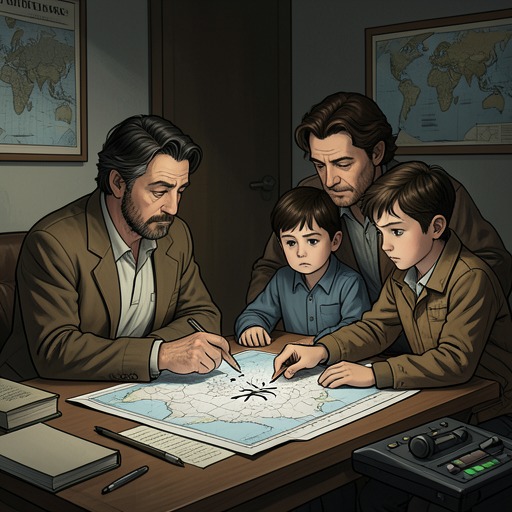
The Postponed Lighthouse Excursion
To the LighthouseThe Postponed Lighthouse Excursion turns a child’s anticipation into a lasting family wound: James Ramsay hears that a trip to The Lighthouse may happen, only to have Mr Ramsay declare it impossible. The weather dispute is also a conflict over how truth should be spoken and whether hope deserves protection. The excursion does not take place the next day, and the evening’s Lighthouse beam leaves James looking toward what has been withheld.
The Promise and the Weather
Mrs Ramsay answers James’s hope with a conditional possibility: “Yes, of course, if it’s fine tomorrow,” adding that he will have to rise early. To James, the qualification scarcely registers. The words seem to settle the expedition, bringing a long-imagined wonder within reach after a night and a day’s sailing. His excitement spreads even to the refrigerator he is cutting from an Army and Navy Stores catalogue, which appears to him fringed with joy. The scene establishes how powerfully an anticipated future can color the present for him.
Mr Ramsay interrupts that imagined certainty when he stops at the drawing-room window and says, “it won’t be fine.” Later, he makes the prediction categorical: there is no possible chance of going to The Lighthouse tomorrow. The falling barometer and west wind support his forecast, and Mrs Ramsay does not claim that good weather is certain; she points out that the wind often changes. The immediate stakes are practical, but the opposing statements carry different kinds of authority: his rests on a reading of present conditions, while hers keeps open a possibility that matters to the child.
The Family Dispute
James’s response to his father’s contradiction is violent in imagination. Hating Mr Ramsay, he would seize any nearby weapon to kill him. The intensity is prompted not merely by the cancelled prospect but by what James sees as his father’s pleasure in disillusioning him and ridiculing Mrs Ramsay, whom he considers immeasurably better than Mr Ramsay. His father’s mere presence can provoke such extremes in the children, and the forecast becomes a concentrated instance of their hostility.
Mr Ramsay treats factual accuracy as an obligation that overrides consolation. He believes children should learn that life is difficult and that hope can be extinguished; in his view, he has neither altered a fact nor softened an unpleasant truth for anyone’s convenience. Yet the narration makes the cost of this principle immediate. Mrs Ramsay’s modest allowance that the weather might improve enrages him as irrational and dishonest. He stamps his foot and curses her, even though he recognizes that she has said only that fine weather is possible. His own forecast may be right, but certainty does not make his response considerate.
Mrs Ramsay experiences his insistence as a breach of human decency. To pursue truth without regard for another person’s feelings seems to her a brutal tearing of civilization’s thin veils. She does not answer his rebuke; instead, dazed, she bows her head as if enduring a pelting of hail and dirty water. The encounter therefore leaves no negotiated resolution between them. It exposes a marital and parental disagreement about whether care requires protecting hope, even when the outcome cannot be promised.
The Evening Light and the Disappointment
Later, Mrs Ramsay remembers that Paul Rayley, Minta Doyle, and Andrew Ramsay have not returned, and worries that one of them might be hurt on the dark paths or rocks. She nevertheless finishes reading James’s story without changing her voice. When the story ends, James’s attention shifts from its imagined world to a pale, wondering gaze. Looking across the bay, Mrs Ramsay sees The Lighthouse lit: its light crosses the waves in two quick strokes and then one long steady stroke.
The beam makes the anticipated destination visible without bringing it nearer. Mrs Ramsay knows James is about to ask whether they are going to The Lighthouse, and knows that she must tell him no, not tomorrow, because his father has said so. Mildred arrives to take the children away, and the bustle distracts them before the question is asked. James still looks back over his shoulder as he is carried out. Mrs Ramsay is sure he is thinking that they will not go the next day, and believes he will remember the disappointment all his life.
Consequence and Significance
After the children leave, Mrs Ramsay gathers the catalogue pictures James has cut out, including a refrigerator, a mowing machine, and a gentleman in evening dress. The ordinary scraps recall the private world that had been illuminated by his hope. Her conclusion is that children do not forget, which makes the adults’ words and actions consequential beyond the moment of the argument. The disappointment matters not because the evidence establishes a permanent injury, but because Mrs Ramsay recognizes that a seemingly small domestic exchange may become fixed in a child’s memory.
The episode gives the excursion’s postponement two incompatible meanings. For Mr Ramsay, refusing to promise what the weather cannot support is an exercise in truth and preparation for a difficult life. For Mrs Ramsay, the same insistence, delivered without tenderness, needlessly wounds a child and humiliates his mother. James experiences the contradiction not as an abstract debate but as the destruction of a radiant expectation. The Lighthouse, visible across the bay after the refusal, holds these meanings together: it is both a real destination ruled out by the weather and an image toward which the family’s hopes remain directed.